Some Elementary Science

  1. Units
  2. Time, distance and motion
  3. Energy, work and power
  4. Waves
  5. Radiation
  6. Chemical changes

Units

The SI system has 7 "base units" that are supposed to be indepndent of one another. See http://physics.nist.gov/cuu/Units/ for an authorative and readable account.

Measurement of what?Name of unitSymbolNote(s)
length (distance)metermone ten millionth (10-7) of the distance from the North Pole to the equator on a line (the meridian) passing through Paris
masskilogramkgmass of a certain reference at the International Bureau of Weights and Measures
timesecondsno short answer but probably originally of Babylonian derivation (they counted in 60s) but re-defined in terms of an atomic frequency
electric currentampereAstrange circular definition of this and the coulomb (C; unit of charge) 1 A = 1C per s.
temperaturekelvinKThe size of the unit is the same as the Celsius scale i.e. 1 degree K = 1 degree C but whereas 0 C is the temperature of melting ice, 0 K is the lowest temperature that is absolutely possible "absolute zero"; 0 C = 273.15 K
chemical amountmolemol"gram molecule". Note this is not an abstract idea: 1 mol of water is 18 grams.
luminous intensitycandelacdI think an arbitrary unit

Start of this page

Time, distance and motion

1 metre per second, written as 1 ms-1 is either a speed or a velocity. The difference between these words is that "speed" has magnitude (size) only whereas velocity has magnitude and direction. They are examples of scalars and vectors respectively. Two people are walking slowly towards one another on a straight road: each has speed of 1 ms-1 (just over 2 miles per hour) but their velocities are 2 and -2 and their relative velocity (i.e. the apparent of one person looked at from the point of view of the other one) is 2-(-2), i.e. 4 ms-1.
Acceleration (a vector) is the rate of change of velocity with time and its units are metres per second per second written as ms-2.
Start of this page

Energy, work and power.

A force is something that effects a change. A good example is kicking a football lying on the ground. Before you kick it is stable and still and following the impact it accelerates. It easier to kick a baby's little toy football than a full size one. In general:
force = mass × acceleration [this is Newton's 2nd law of motion].
The units here are kg.m.s-2 and this unit is called the newton (N). There is a distinction between mass and weight: as the acceleration due to gravity at the surface of the earth is approximately 10, a 1 kg mass has a weight of 10 N.
In the XIX century it was recognised that energy or work (the consequence of energy being expended) can be converted from one form to another so we do not need separate units for heat energy, mechanical energy etc. The unit of energy (or work) is the product of force and distance (N.m = m2.kg.s-2) and this is called the joule (J) and the rate at which this is done (joules per second) is power, unit the watt (W).
There is an older unit for energy/work called the calorie (cal). This has led to an unfortunate use in popular literature on diet. There is no objection to identifying the energy associated with food. The calorie is the energy required to raise the temperature of 1 g of water through 1 degree Celsius: a very small quantity. So if we look at the approximate numbers of "calories" in some common kinds of food, they looks pretty harmless:
No (sorry!) what they mean are Kcal (thousands of calories). 1 calorie is approximately 4.2 J so the hot dog is around 4.2 × 400000 J.
Start of this page

Waves

In everyday life we come across waves: at the seaside, hearing sounds (it has been known for thousands of years that musical notes are composed of vibrations).
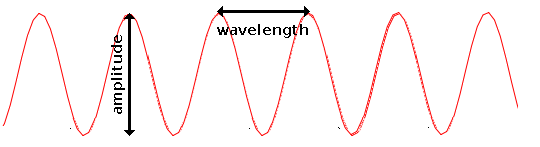
Here is a static picture of a wave (it is a sine curve).
As an alternative to wavelenth (conventionally lambda, λ), waves can be defined by frequency. The waves are propagated at a speed, the phase velocity v and instead of wavelength one can use the expression v/λ: this is the frequency. The units of frequency are s-1 known as the hertz (Hz).
There two simple ways in which can be propagated; transverse and longitudinal. An everyday exmple of proagation of a transverse wave would be waves at the seaside. If the tide is coming in (or going out) and you look at a particle on the surface (e.g. a seagull) it is seen to be bobbing up and down. Light and other forms of electromagnetic radiation or propagated in this way.
A longitudinal wave (of which sound is a good example) has vibrations in the direction of propagation.
There is an excellent introduction to wave motion with animation from the University of Aukland.
Start of this page

Radiation

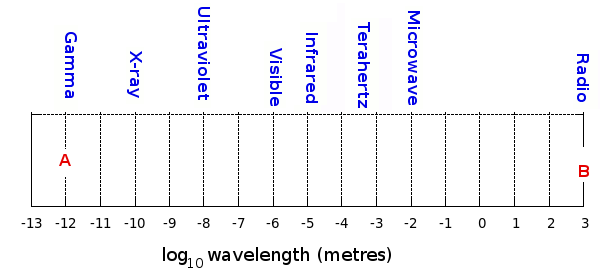
Visible light is a tiny part of the electromagnetic spectrum. The range of different types of electromagnetic radiation is shown in the picture below. It is important to realise that this is shown as a logarithmic scale. For example the wavelength at A is 10-12 (a millionth of a millionth) of a meter whereas B is 1 km. Visible light covers a range from 0.4 to 0.75 × 10⁻⁶m. For some reason these are usually referred to 400 to 750 × 10-9m [10-9m is called a "nanometer" (nm)].

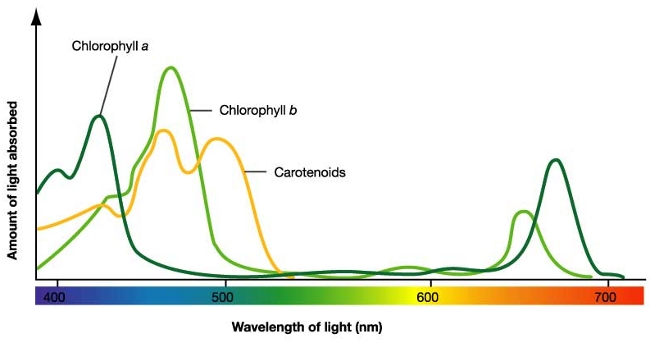
When radiation passes through a substance some of it is absorbed to create an absorption spectrum. Such specrtra are extremely useful in determining chemical structures etc. The next picture taken, from the University of Illinois (Chicago) shows such a spectrum of coloured chemicals (i.e. pigments) taken from the green parts of a green plant. The important point is to distinquish carefully between absorbed and reflected light. Looking just at the spectra of the chlorphylls. These are the chemicals that result in the green colour of the leaves of plants. There is no absorption in the green part of the spectrum: the other colours are absorbed so the green light is reflected. Similarly carotenoids (coloured like carrots) are yellow/orange/red) because the shorter wavelengths (blue, violet) are absorbed.

Start of this page

Chemical changes

We are going to use the term "chemical" rather generally. In fact we are going to try and introduce some key features of the subject of thermodynamics, a word interpreted by generations of students as meaning the ultimate in boredom. It is not actually boring but (even you think it is boring) it is very important. It is an everyday fact that some processes, including chemical changes generate heat (lighting a fire, dissolving certain things in water...). These processses are known as exothermic. Heat is a form of energy and one cannot create energy from nowhere. In fact for a system (e.g. lump fo coal and a lighted match), energy is lost from the coal and gained by the room or fireplace. We say that such a process is exothermic and the change in heat content (a concept of the potential for the coal to burn) is represented as a negative value.... i.e. we look at the change in heat content as the from the point of view of the system. This, if put more formally is the first law of thermodynamics. Or we can say that energy cannot be created from nowhere but can only be intercoverted. Some processes are endothermic (i.e. the heat content change is positive). An everyday example (without going into the mechanism) is a refrigerator. Somehow or ever electrical energy cools the thing down. Another example which is easier to see from first priciples is adding salt to snow. The snow melts but more importantly, it actually gets colder. Try it out next winter. Another way of formulating this law is to say that it makes a perpetual motion machine of the first order impossible. A somewhat more subtle point is that the efficiency off such a process is limited. The first person to recognise this was a French railway engineer called Nicolas Léonard Sadi Carnot. Carnot was studying the way in which in a steam engine (a railway locomotive) could be more efficient. We can look at the expansion and compression of the steam in the cylinder. It was well known by Carnot's time that the law (i.e. mathematical formulation) that governs the relationship between pressure, volume and temperature of a gas is give approximately by the relationship:
pressure × volume = constant × absolute tempertature.
The "constant" is actually a product of the amount of gas × the universal gas constant (R). The amount of gas (usually N) is measured in mols so the equation becomes
PV = NRT
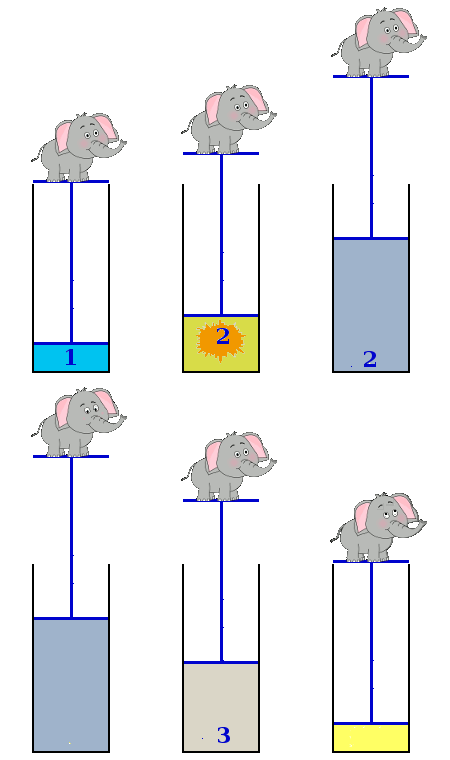
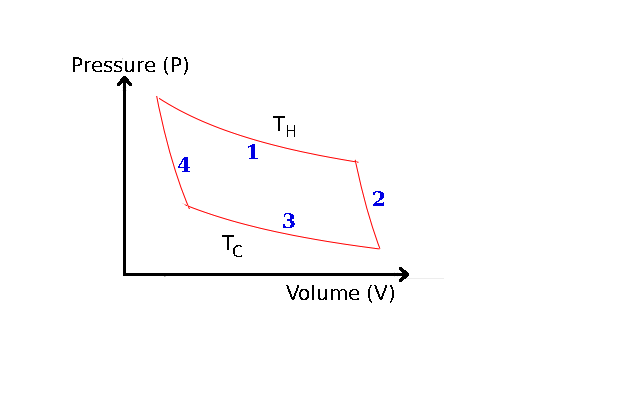
A theroretical gas for which this relationship is absolutely true is called an ideal gas. Carnot considered an ideal heat engine in which such a gas is heated up, expands, cooled down and contracts and heats up. This is the Carnot cycle. Rather than considering the complicated case of a cylinder and the connecting gear on a lococomotive let's just look at a simpler case (!) i.e. not driving a train but lifting up an elephant.
There are four stages in the cycle:
1: expansion at the higher temperature
2: "adiabatic" expansion
3: compression at the cooler temperature
4: "adiabatic" compression

Although in stage 4 the weight of the elephant compresses and heats up the gas, it still requires heat energy to keep it going for another cycle. The work done (lifting the elephant) ÷ energy supplied is the efficiency. By writing down the equations it transpires that the effects of all the other varibles cancel each other out and:
Efficiency of an ideal heat engine = (TH - TC)/TH
This is important in designing heat engines: the difference between TH and TC) should be as large as possible. More importantly, what has happened to missing energy?
We need to define two (at first sight rather abstract) ideas. Let us call the energy to create the "system" (the gas in the cylinder in this case) as the internal energy U.
The work done to/by the system is PV and we call H (= U + PV) enthalpy or heat content. Now we can develop the concept of usable energy called free energy. In order to do this we introduce another rather abstract idea which is entropy S. There are two types of free energy named after their inventors or discoverers:
Helmholz free energy F = U - TS
Gibbs free energy G = H - TS
In simple terms, G is used to predict whether a process can happen at constant temperature and prssure. We shall concentrate on G. Although G, H and S seem to difficult to get our hands on changes in these can be measured. A change is represented by a capital delta (the Greek equivalent of D), Δ.
Formulated in these terms:
ΔG = ΔH - TΔS
ΔS = Q/T where Q is the heat absorbed by the system.
The second law of thermodynamics can be expressed by saying that ΔG must always be negative (lost by the system) and ΔS must be a positive value (including 0).
We are left with four questions about entropy.
  1. What is entropy? From where we have arrived, it has the units of J.K-1 and is a measure of the the energy unavaible for doing work.
  2. Surely there are processes that seem to contradict the second law of thermodynamics? Yes, specifically chemical reactions that occur in living creatures (including humans). It is true that these reactions include extremely unfavourable (postive ΔG changes) such as synthesis of complicated molecules, warming ourselves in cold weather... The point here is that the unfavourable processes are linked to favourable ones. Eating calorific food is equivalent to burning it so if you digest a meal of fish and chips and cream cakes, you convert these into water and carbon dioxide (very favourable, large negative ΔG) which provide the free energy to drive unfavourable process.
  3. Does this mean that if the whole universe is a "closed system", then it is running out of free energy (maximum entropy)? Probably(!).
  4. Does entropy apply in cases other than physical/chemical changes? Yes, it is a measure of chaos or homogeneity and applies in theories of information pioneered by C.E. Shannon.

Start of this page